1 Some Background Information
Entries in this section (8)
- 1.1 What do we know about Arnold Hendrick, designer of Darklands?
- 1.2 What did Microprose say about Darklands?
- 1.3 Where do I find Darklands now?
- 1.4 Did I hear somebody say, “sequel”?
- 1.5 Who else made Darklands?
- 1.6 Who owns Darklands now?
- 1.7 Are there remakes or successors?
- 1.8 Was anything cut from the game?
1.1 What do we know about Arnold Hendrick, designer of Darklands?
Before he designed games for Microprose, Arnold Hendrick worked in board and miniatures games. From 1979 to 1982 he was publishing director of Heritage, where he ran the Dwarfstar Games line with Howard Barasch. Of note: Grav Armor (Dwarfstar), a tactical combat game, and Barbarian Prince (also Dwarfstar), a paragraph adventure boardgame, which won the 1981 Charles S. Roberts award for best fantasy board game. He was also involved in Trireme from Avalon Hill (Redesign and Development). After Heritage folded he worked at Coleco from 1983, and in 1985 he joined MicroProse, as, in his words, “the first non-programming designer at that company”.
Arnold Hendrick worked on a number of games for Microprose:
- Silent Service II - project leader;
- F-19 Stealth Fighter - game design by Sid Meier (based on an original idea by Jim Synoski and Arnold Hendrick), playtesting, manual writing, with Joe Morel;
- M1 Tank Platoon - game design, playtesting, manual writing;
- Darklands - concept, game system and project management; game design (with Sandy Petersen and others); manual writing.
Of all of them, he said he was proudest of the original Pirates!, which he made with Sid Meier.
Darklands won the 1992 PC Special Achievement Award from Game Players Magazine. Hendrick left MicroProse in 1995.
From 1995 to 1998 Arnold was with Interactive Magic (I-Magic), as senior designer on iM1A2 Abrams and Panzer ‘44. In 1998 he moved to Kesmai Studios as a senior producer on its Air Warrior flight games; Kesmai was later taken over and closed by Electronic Arts. From 2005 to 2009 he worked on “serious games” and virtual worlds at Forterra Systems.
Arnold wrote an article which was published back in the February 1998 edition of Game Designer Magazine: “How to Hire a Phenomenal Game Designer”.
Mark Kundinger had the following correspondence with Arnold Hendrick which he shares with us:
Date: Thu, 12 Dec 1996 09:03:13 -0500
To: Mark Kundinger
From: Arnold Hendrick
Subject: Re: Random nostalgic momentAt 11:19 PM 12/11/96 -0600, you wrote:
>Hello Arnold,
>
>Hate to intrude on your busy schedule, especially while you’re
>working on iM1A2, but I was just wondering…
>
>You remember Darklands? I sure do. I loved that game, it was so
>different than your typical RPG (having a mob chase you into the monastery
>was great fun). It also served as a handy quick-reference to saints.
>
>Had you had any plans (way, way on the back burner) to do a sort of
>sequel to this? The RPG market is so barren right now I’m sure they’re
>slavering for a new game :)
>
>Anyway, sorry to butt in, and thanks for reading.
>
>MarkMark,
Sorry, but no plans for any such sequel. However, thanks for the appreciative comments. I’m glad you enjoyed the game. :)
Arnold
For years Hendrick kept away from the players’ discussions; in 1999 C. Michel Boucher wrote that he had “resisted all attempts to involve him”. Late in life he came back to Darklands. In 2010 he talked about it at length with Matt Barton on Matt Chat; in 2012 he answered questions for RPG Codex; and from 2016 he answered players on Steam, as “Yasha”, in the thread “Ask the original designer why…”. Much of what we now know about the design comes from those answers.
Arnold Hendrick died on 25 May 2020. His widow, Georgeann Hendrick, wrote to the Darklands mailing list that he “was most proud of Darklands”.
1.2 What did Microprose say about Darklands?
Microprose issued the following press release:
********** DARKLANDS **********
HUNT VALLEY, MD _ MicroProse Software, Inc., famous worldwide for its high-quality entertaining simulations of combat and adventure, will release DARKLANDS, its first true fantasy role-playing game, this fall.
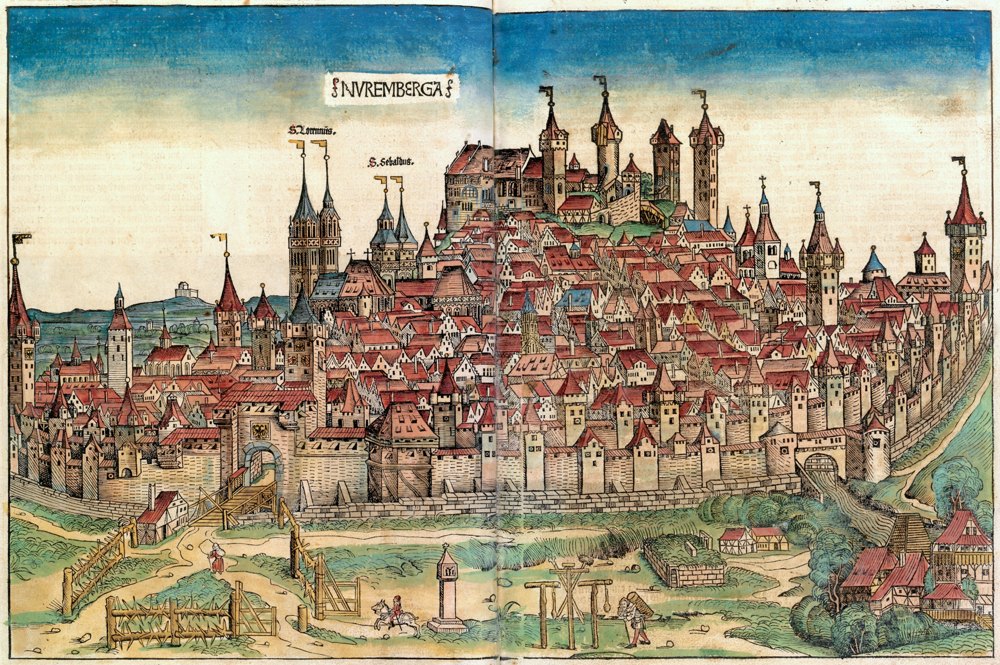
Set in 15th Century Medieval Germany, DARKLANDS will be as realistic and challenging a simulation as previous MicroProse releases. “The common thread of all of our titles, from GUNSHIP to RAILROAD TYCOON, is that they have an intellectual core,” said Arnold Hendrick, DARKLANDS’ game designer. “DARKLANDS will be no different _ the problems and tasks the gamer will face are straight from the events and attitudes of Medieval Germany.” 15th Century Germany was a time of violence and corruption and was an era with three Popes simultaneously in charge, powerless emperors, gangster nobles and venal clergymen. DARKLANDS recreates this period and emphasizes the beliefs of the time: witches worshipping the devil, people praying to saints to produce real miracles, alchemists turning lead into gold and dragons inhabiting caves.
Players will explore a vast map of Germany with a party of four adventurers created from the likes of nobles, swordsmen, mercenaries, thieves, alchemists, monks and several more. Millions of different character types will be possible by choosing from 26 attributes and skills. The ultimate goal of the game will be to achieve fame and immortality on multiple quests, many of them simultaneous. Quests will be created by an “adventure generator” for endless replayability.
DARKLANDS will be released for IBM-compatibles and will require 640K of RAM. The game will support AdLib, Roland, Tandy and IBM sounds, and EGA, MCGA/VGA and Tandy 16-color graphics. A hard disk will be required and a mouse recommended.
The release is undated. “This fall” meant the autumn of 1991: MicroProse’s first Darklands advertisement ran in Computer Gaming World in January 1991, and the French magazine Génération 4 printed the first screenshots in February 1991, from that winter’s Consumer Electronics Show in Las Vegas. The game came out only in August 1992, almost a year late.
Some of the promises changed on the way. The game shipped with a single graphics mode, 256-colour VGA/MCGA, and no EGA or Tandy graphics. Its sound drivers cover AdLib, the Sound Blasters, Roland and the PC speaker, with no Tandy sound. Version 483.07 also needs 176K of expanded memory (EMS) on top of 581K of main memory. The “adventure generator” became a set of recurring quests (mines, dragons, raubritters, sabbats and others) that the game places at random, so each game deals them out differently. The 26 attributes and skills did survive: seven attributes, counting Divine Favor, and nineteen skills.
1.3 Where do I find Darklands now?
The easiest way is a digital copy. GOG has sold Darklands since October 2011, and Steam since October 2014. Both sell the final version, 483.07, taken from the 1995 CD-ROM, with English and German installers, set up to run in DOSBox, and with the manual as a PDF. The game was briefly off GOG around 2019 and 2020, when its publishing rights changed hands (see 1.6); it has been on both stores since.
eBay is the place to go if you are looking for an original box-set with the real manual, the map or the supplementary Clue Book. Be prepared, however, to pay a premium for original, out of print materials. CD-ROM copies often came without the printed map.
The sources earlier versions of this FAQ recommended, the Ultimate Darklands shop, Yahoo! Auctions and the Game Trading Zone, no longer exist.
How to run it on a modern computer is in section 2.
1.4 Did I hear somebody say, “sequel”?
The manual for Darklands promised sequels. It tells a party that has had enough of Germany to “await new challenges elsewhere in Europe (in forthcoming sequels)”, and asks you not to erase a retired party’s saved game, because “forthcoming sequels may use this file”. This never materialized, but gamers are a persistent bunch and every now and then, the questions re-emerge.
This is what was said about a sequel (straight from the horse’s mouth, as it were):
From: polar@u.washington.edu (B. Power)
Newsgroups: comp.sys.ibm.pc.games.rpg
Subject: Darklands: Dead. *sigh*
Date: 3 Sep 1995 17:26:41 GMTSeveral weeks ago, I sent Microprose mail about a possible sequel to Darklands. Here’s what I received:
-—————-
Date: Wed, 26 Jul 1995 11:05:12 -0400
From: MPS/SH On-Line
To: Brendan Power
Subject: Re: Darklands: Dead in the water?Hi Brendan,
There are no plans for a newer version of Darklands, or to license out the source code.
Regards,
Tim/Spectrum HoloByte-MicroProse
The following message from Erik Novales also reinforces the notion that Microprose does not wish to get involved with Darklands:
Subject: Darklands
Author: Erik Novales at Gateway
Date: 10/25/95 11:20 PMTo whom it may concern,
At the behest of the authors of the DARKLANDS FAQ, and also partly out of my love for that game of old, I’m writing to express my support for the effort to either a) produce Darklands sequels, as was stated in the game manual, or b) release/license the source code to concerned net.citizens to produce themselves what is so evidently desired–a good RPG using an engine whose quality is unequalled today. I urge whomever happens to be in control of these matters to give serious consideration to these two proposals, as I see a great deal of potential in the Darklands engine, especially in the light of recent, ‘AVI-based’ games that push bells and whistles over subtance. Thank for your attention.
Erik Novales
-—————–
Date: Thu, 26 Oct 1995 14:02:34 -0400
From: MPS/SH On-Line
To: Erik Novales
Subject: Re: DarklandsHi Erik, Thank you for your interest, however, there are no plans for a sequel (as the game’s lead designer and programmer no longer is with the company) and we do not release our code into the general net community.
Regards,
Tim/Spectrum Holobyte-Microprose
That was MicroProse’s position to the end. Computer Gaming World explained it in June 1994, answering a reader: MicroProse had planned three games, Germany first, because Hendrick thought it the most violent and superstitious of the medieval cultures, then medieval Britain and Italy. But the game had not sold well enough, and its “engine” could not be reused, so a sequel would cost nearly as much as the original. “In short, we don’t ever anticipate a sequel.”
Hendrick said much the same on Steam. After what Darklands had cost, MicroProse “had no appetite for sequels”, and moved him to its console group. In 2016 he reckoned a modern sequel would need at least ten million dollars, and said he would gladly design one if someone found the money. Nobody did.
1.5 Who else made Darklands?
The manual’s credits and its short account of how the game was made name the team:
- Concept, game system and project management: Arnold Hendrick, who did the first design and research and then brought in “first Sandy Petersen, then Doug Kaufman” to help.
- Game design: Arnold Hendrick and Sandy Petersen, with Doug Kaufman, Jim Synoski and Doug Whatley.
- Programming: Jim Synoski and Doug Whatley, with Bryan Stout. Synoski, who had written the original F-19 Stealth Fighter, did the first programming and the whole animated battle system. Whatley took over the menu logic, the map and the world data, and Stout supplied “black boxes” to glue the game together.
- Art: Artino (Matt Scibilia), Chris Soares, Jackie Ross, Rawn Martin, Patrick Downey, Erroll Roberts and David Menehan, with art direction by Michael Haire. Artino drew each scene in pen and made the opening and closing animations; Soares did much of the colouring; Ross designed the battle animation, which Martin and Downey finished.
- Music: Dr. Jeffery Briggs. Sound programming: Ken Lagace, Jim McConkey and Scott Patterson.
- Manual: written by Arnold Hendrick, edited by B.C. Milligan and Doug Kaufman. Testing was led by Michael Craighead.
1.6 Who owns Darklands now?
MicroProse merged with Spectrum HoloByte in 1993, and Hasbro bought the company in 1998. At the end of 2000 Hasbro sold Hasbro Interactive to Infogrames, whose American arm took the name Atari in 2003. When Atari’s American companies went bankrupt in 2013, Darklands was among the minor titles sold to Tommo, Inc.; the court’s sale order was entered on 25 July 2013. Tommo’s Retroism label, with Nightdive Studios, put the game back on sale. Ziggurat Interactive has been its publisher since about 2019 and announced its GOG re-release in March 2020. No record of the step from Tommo to Ziggurat has turned up.
1.7 Are there remakes or successors?
Fans tried several times. The remakes of the 2000s, among them the SourceForge “Darkworlds” project, stalled, and so did the C# remakes of 2010 and 2011, which had working character creation and battles. Mods brought Darklands’ ideas to Oblivion and Mount & Blade.
Hendrick spent his last years on a successor of his own, Free Companions: A Cursed Kingdom, set in France during the Hundred Years’ War. Matt Scibilia, the game’s lead artist, said in 2026 that he was still working on it. Dixit Dominus (from 2022) and Nürnberg (announced in 2026) are new games made in Darklands’ spirit rather than remakes.
The Darklands Restoration Project rewrites the original program’s rules in C#, so the game runs natively and plays exactly as 483.07 does, using the data from your own copy. See the project FAQ.
1.8 Was anything cut from the game?
A good deal. Hendrick wrote on Steam in 2017 that the design was “WAY too ambitious”, and that some of it “snuck in” as text and data but got no further. The program still holds some of these unfinished parts:
- City politics. There are scenes for siding with a city’s rebels or its council and planning a revolt, but they end in the game’s own placeholder: “Sorry, this option isn’t working yet.”
- The barracks. A city barracks scene offers weapons training and recruits, but the city square never shows the way there, and its options would lead to the same placeholder.
- Horses. The clue book says a party with a horse for everyone travels faster. Each time the map opens the game works out whether every member is mounted, and then never uses the answer (see 3.11).
The manual and the clue book also describe things the game never had, such as the Hall of Fame.