6 Summary of the Darklands Hint Book
Entries in this section (1)
6.0 Summary of the Darklands Hint Book
Where the clue book and the manual disagree, the clue book is usually the one to trust; Arnold Hendrick said as much on Steam in 2017. It is not always right either. The figures quoted below have been checked against version 483.07, and the few that the game does not bear out are corrected in place.
Ebhard’s Guide
Character Creation
The Wealthy Urban row above is corrected to the game’s figures: version 3.0 had End −1 and Per +1, but the childhood gives Perception +2, Intelligence +1 and Charisma +1, with no change to Endurance. The ages in the aging table are those at which a five-year term begins, and each penalty is applied at the end of that term: a character who has just turned 50 has lost 7 points of Agility, and reaches 10 only at 55. Two details the table does not show: the price of a skill point rises from 1 experience point to 2 once the skill reaches 49, and to 3 at 79, and every skill gets +2 free in the first term after childhood. The full rules are in 3.1.
The World
Of the 92 cities, ten are size 3, 24 size 4, 40 size 5, eleven size 6, six size 7, and only Köln is size 8. The quality a shop offers is the average of the item’s own quality and the shop’s figure for that city, and no city’s shop figure is high enough to lift ordinary goods (quality 25) past 39. Quality 40 and better in a shop means a Composite Bow from the bowyers of Olmütz, Teschen, Pressburg or Elburg, or one of the rare relic weapons.
The saints really are fixed for each game: the four a church or monastery library offers are drawn from the game’s own seed and the place, so they stay the same for the whole game and change from one game to the next.
Equipment and Combat
Every figure in these two rows matches the game except the prices, which follow the shop’s own reckoning (see 3.2). Strength above the top of the weapon’s range adds a level of damage at once, and another for every 5 points more; below the range, damage and the chance to hit both drop.
Enemies
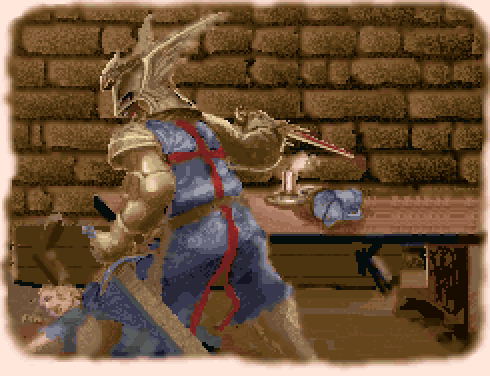
The Templar figures are exactly those in the game’s enemy file. Their “potions” are charges they throw in battle, not items you can take from the body. A type B has an even chance of one or two Noxious Aromas; the Preceptor always has one to four, and an even chance of an Eater Water. Both also carry Black Cloud charges, which the game never lets an enemy throw.
Alchemy
The formulas, magic numbers, risks and ingredients are the game’s own. The magic number is taken away, not added, and k is 100 only when you brew up to three potions at once; it falls to 50 for four or five, 33 for six or seven, and 25 for eight or nine. Fleadust takes its percentage from the seven weapon skills only, and it works on your own party as well as the enemy’s. For everything else about alchemy, including two original bugs that make the “Risk” column work backwards and Hardarmor last forever, see 3.3.
Religion
St. Peter needs Virtue 58; the effects are right, and they last between 19 and 21 hours. In a city’s dungeon he can set the whole party free, at some cost to your standing in that town. How the prayer chance is worked out is in 3.4.
Quests
There are exactly eight lairs, at the places listed. Two of the book’s compass directions are wrong: lair (a) lies north-west of Hannover, not north-east, and lair (d) south-south-east of Stettin, not south-south-west. Only one lair holds a dragon at a time. At the start of each month with no dragon about, there is a one-in-four chance that one moves into the lair nearest the party’s position (any lair, if the party is out in the wilderness), blights the villages around it, and stays for a year or until it is killed. A dragon you hear of in town is most likely in the lair nearest to where the party was when the month began. More in 4.12.
Puzzles and Answers
“His son” is the answer in the game too. A wrong answer at this door costs the party’s leader 1 point of Strength for good, and lowers his maximum Strength by one as well; other riddle doors take other attributes the same way. The “power” in MEM.LOG is the figure the game uses to size the groups you meet. It goes from 1 to 10 and is worked out from the party’s average best weapon skill, best missile skill, average Virtue and average Alchemy, less 2 for a lone character and 1 for a pair, plus 1 for a party of five.