4 Specific Quests and Encounters
Entries in this section (20)
- 4.1 Refugees and Pilgrims
- 4.2 Hermits
- 4.3 Travelling Alchemists
- 4.4 Merchants
- 4.5 Knight enroute to Jousting Tournament
- 4.6 Extortion by Nobles and Clergy
- 4.7 Recovering Items
- 4.8 Raubritters
- 4.9 Mines and Knockers
- 4.10 Solitary Women
- 4.11 Satanic Villages
- 4.12 Dragons
- 4.13 Wild Hunt
- 4.14 High Sabbat
- 4.15 Great Monastery
- 4.16 Baphomet
- 4.17 Why are maidens sacrificed to a dragon, and can I stop it?
- 4.18 When and where are the witches’ sabbats?
- 4.19 Tombs, the undead and purifying
- 4.20 How should I prepare for Baphomet? Can a small party do it?
4.1 Refugees and Pilgrims
What do I get for helping them?
Divine Favor, every time. Alms (a sum between 3 and 52 groschen, drawn at random) and giving away your mounts each raise every member’s Divine Favor by a quarter of their Religion skill plus 4. Escorting the pilgrims takes one to three days and gives a fifth of Religion plus the number of days. Giving away the mounts means all of them, every horse and mule the party owns, and the option only appears when every member is mounted.
Virtue rises only now and then: each member has a small chance (about one in twelve for alms, one in four for the mounts) of gaining a point.
The food and clothing for refugees cost a twentieth of your purse plus one pfennig, at most two florins.
Are the refugees always what they seem?
No. About one band in seven (14 in 100) is bandits in disguise. Giving them food or praying for them gives the game away: a party with a sharp-eyed member may sense the trap in time, otherwise the bandits attack.
4.2 Hermits
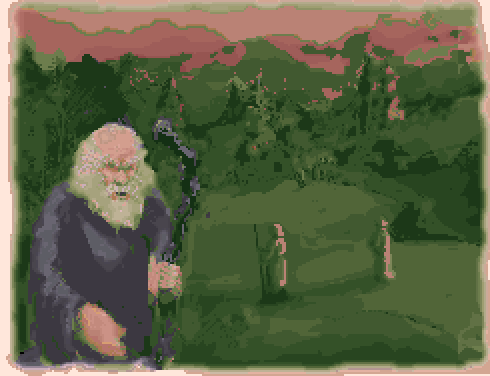
How do I get the hermit to talk, and what can he teach?
Hermits live in wild country, never on the roads. Whether he comes out to meet you depends on the leader: a third of Speak Common, a third of Virtue, a quarter of Religion and half of Perception, added up. Once he does, you can choose one of three things:
- Stay until noon and learn about the faith: everyone has a chance to gain Religion.
- Pray with him: everyone gains 25 Divine Favor; you stay until noon the next day.
- Hear about a saint: one of your first four characters (you choose which) learns a saint picked at random from all 136. If that character already knows it, he only hears good stories.
4.3 Travelling Alchemists
In version 483.07 the potion you trade does leave your pack. What you can do is trade again and again, as long as you carry one of the two potions he asks for, since he names a new pair each time.
Cover works, though not quite as Myles describes. An enemy alchemist who can see no one moves to look for a clear throw, and he goes over to his hand weapons when your fighters get close to him. He also uses up a potion each time he decides to throw, before he checks whether anyone is in view, so a party that stays hidden can drain his supply.
What does the friendly alchemist trade?
He asks for one of two potions, one from each of these groups, drawn anew each time: Thunderbolt, Eater Water, Arabian Fire or Breath of Death; and Strongedge, Great Power, Hardarmor or Transformation. In exchange he offers one of fourteen others, also drawn at random: Noxious Aroma, Eyeburn, Sunburst, Black Cloud, Stone-tar, Fleadust, Deadly Blade, Trueflight, Truesight, New-wind, Ironarm, Quickmove, Essence o’Grace or Firewall. Leaving costs nothing.
What does the aggressive alchemist want?
All your alchemical goods: every potion and every ingredient the party carries. You can hand them over, say you have none (only when that’s true), plead, or fight. Pleading works with a chance of half the leader’s Speak Common plus Charisma; if it fails, you fight. Losing the fight costs you the goods anyway.
4.4 Merchants
It’s been said that commerce drives the engine of growth. The same was true 600 years ago. If you come across travelling merchants, one of two things may happen:
- They’re disguised bandits that will attack you when you approach them about buying or selling (about one caravan in eleven).
- They’re friendly and offer to buy or sell goods.
For the hostile bandits, you can only fight them off, unless someone in the party is sharp-eyed enough to see through the disguise in time; then you can still try to run. By the time they reveal their intents, you’re plunged into battle. The friendly merchants, on the other hand, will trade with you, or even agree to travel with you to a nearby city (thus ensuring safety for the sojourn).
How do I spot the bandits?
When you approach them, the game adds a random 0 to 19 to the best Perception in the party; 60 or more and you recognise the bandit leader before the ambush. So a Perception of 41 gives a slim chance, and 60 or more makes it certain. Running away then depends on the party’s average Agility (reduced by what they carry) plus the best Woodwise. A prayer to St. Catherine of Siena, St. Dorothy of Montau, St. Herve or St. Martin of Tours also unmasks them.
Losing to the bandits is about the worst thing that can happen on the road: the member with the least Strength is killed, and the others are robbed and left for dead.
What do the merchants sell, and is travelling with them worth it?
A caravan deals in one kind of goods only, and which kind depends on where on the map you meet it.
To travel along, you have to ask. The chance is half of: half the leader’s Speak Common, plus the leader’s Charisma, plus the party’s average Virtue. The journey takes 2, 4, 6 or 8 days and ends safely at the nearest city, and every member gains Divine Favor (a fifth of Religion plus the number of days).
4.5 Knight enroute to Jousting Tournament
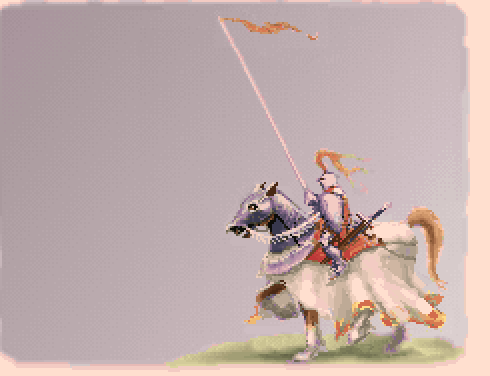
Winning brings no fame or standing: only Riding practice, and a florin if your purse is almost empty. The numbers are the Virtue each saint needs. St. Christopher (who also needs 15 Divine Favor) raises Riding by 25 to 74 for a day; St. George (40 Divine Favor) raises Riding and every weapon skill by 25 to 49, along with Strength and Agility.
How does the race or joust work?
You need at least one horse to take part. The knight accepts the challenge only if your party is famous enough: the chance is three times your fame, in percent.
- The race is ridden by the member with the best Agility plus mount. His Riding and the quality of his horse are set against the knight’s and his horse’s random strength. A Superb Horse (quality 70) counts for much more than a Mule (5).
- The joust is fought by your strongest member. His Riding and Polearms, and half his horse’s quality, are set against the knight, his horse and his lance. A close result goes to a second pass.
Losing costs nothing.
4.6 Extortion by Nobles and Clergy
How much do they ask, and how much does refusing cost?
| Asks | Talk them out of it | Fighting their men | |
|---|---|---|---|
| Nobleman | 6 pfennigs (purse under 30 pf), 2 groschen (under 300 pf), otherwise 20 groschen | fame + leader’s Speak Common | no Virtue lost; if you win, −20 to −29 standing in the nearest city |
| Bishop | about a fiftieth of your purse plus a hundredth of your bank notes, at most half the purse; nothing if you have 10 pfennigs or less | party’s average Virtue + half the leader’s Speak Common | every member −2 Virtue and −25 Divine Favor, win or lose; if you win, −10 to −19 standing |
| Dominican friar | a pardon: a sixtieth of your purse plus 3 pfennigs per member | pray to Godfrey, John Nepomuk or Dominic; or frighten him with a Sunburst or Thunderbolt | every member −2 Virtue and −30 Divine Favor |
Talking a nobleman round depends on your fame as much as on your leader’s tongue, and a bishop listens to the party’s Virtue. A Sunburst or Thunderbolt thrown at a Dominican’s feet sends him off too. The standing losses are not certain, like every change of standing (see 3.8).
Riding off needs every member mounted. The chance is the Agility of the least nimble rider plus the quality of his horse, plus half the best rider’s Riding, so a Superb Horse (quality 70) almost guarantees it. If it fails, the guards empty your purse and take much of what you carry.
The friar’s curse hits each member for (100 − Virtue) ÷ 14 + 1 points of Strength and Endurance, four times that in Divine Favor, and half of it again from the maximum of Strength and Endurance, permanently. Only a character with Virtue 87 or more escapes the permanent part.
4.7 Recovering Items
Building collections has always been a favorite past-time of the wealthy. Be it Jay Leno with his cars and motorcycles or the local Fugger and his rare antiquities. Lesser bounties during negotiations with Fuggers, Medici, or Hansards usually point to a retrieval-type quest. You’re given the basics of the commission: the item of import, a bit of background, and last-known location.
How do I get into the rival’s office?
There are four offices (the leading merchant’s, the Fuggers’, the Medici’s and the Hanse’s), and one of them is trapped.
- Picking the lock: twice the party’s best Artifice, at least 20%. At the trapped office the chance falls by twice the town’s size, and a very bad roll springs the trap, which burns the picker’s face: Charisma and Perception drop, partly for good.
- Eater Water: the potion’s quality plus twice the best Artifice. Quiet.
- Thunderbolt: the same chance. If the stolen item is in this house, the blast finds it at once, whichever door you chose. If not, the noise may bring the guards; whether you slip away depends on the party’s average Agility.
For the crypt, and why a won fight there loses the item, see 4.19.
4.8 Raubritters

When offering your party’s services to potential sponsors, you may be offered a raubritter to deal with. The pay depends on the size of the city (from 3 for a small town to 8 for Köln): five florins per point of size from a market’s merchants, seven from the city lord at the town hall, so between 15 and 56 florins. Expect some mercenary work.
The friendly approach doesn’t depend on the difficulty level. Nor does the game wait until you are ready before offering the job: the offers are chance. What it does is size the knight’s bands to your party (see 3.13), which is why a careful group usually can do the deed. When the knight dies, every patron who gave you the job pays.
How do I take a raubritter castle?
The castle offers several ways in: lay siege, attack it with potions, ask to come inside, challenge the knight to single combat, sneak in after dark, call on a saint, storm it, or go away.
- Siege. Each day of siege brings a fight with a sally of his men (two bands of three to seven), or with the knight himself. The game counts every sally you beat and every successful potion attack; the higher that count, the sooner he comes out in person. Below two he never does; at four or more he always does.
- Potions. A Thunderbolt against the gate breaks it open with a chance that grows by 10% with each one thrown, and leads straight to the final fight. Arabian Fire sets the castle burning: the first fire brings the knight out one time in four, and each further fire adds one in eight. Eater Water, or a Thunderbolt that doesn’t break through, weakens the gate so that you can storm it during the next three days.
- Asking to come in works as long as you haven’t raided him. Fame above 200 makes him forget one raid, and fame above 400 another.
Do burnt castles come back?
Yes. Every third month the game rebuilds one ruined raubritter castle, the one farthest from the party, with a new knight in it.
Why do I keep fighting the same raubritter?
That’s a bug of the original game, well known on the Darklands list. If you sneak into the castle at night and set it on fire, and the knight comes out and dies, the game sends you back to the castle gate instead of the map. You can then go in, set the fire and kill him again, and take his men’s arms and armour every time. Many players have farmed a fortune this way. Leave, and the castle is a ruin.
A related bug works against you: if the knight is killed during a fight from which your party flees, the castle falls but the quest is never counted as done, so no patron pays.
4.9 Mines and Knockers
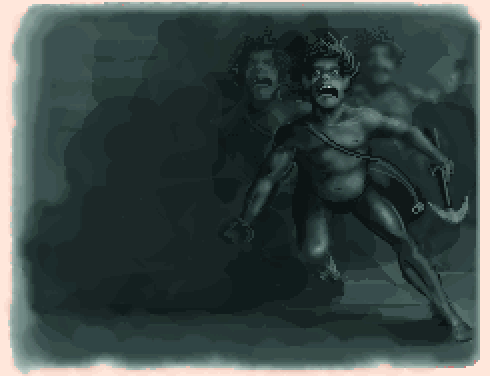
How does a mine get into trouble?
At the turn of each month, if no mine quest is running, there is a one-in-three chance that one starts at the mine nearest to the party. It lasts a year. Which of the three troubles it is, is drawn at random. The “raising the dead” trouble itself comes in three forms: a tomb of the undead, a firespout of vulcans or a hellgate of demons.
At the source of the horrors you can bury it under rocks (the party’s average Strength is the chance), build a barricade (the best Artifice in the party), pray to St. Boniface, St. Emydius or St. Raphael, or use a potion: Firewall on the firespout works four times in five, Transformation on the hellgate always works. A failed attempt lets more horrors through, and that way can’t be tried again for a week.
Clearing a mine is worth 25 fame, a rise in standing in the nearest city, and 10 to 14 each of Pure Gold, Orpiment, Manganes, Zincblende, Antimoni, White Cinnabar, Nikel, Pitchblende, Zinken and Brimstone, all given to the leader. The mine is closed for good afterwards.
What about the dwarf king’s treasure?
There are no crown jewels to carry off. The king’s treasure is in a locked stone box. You can hammer it open (your weapons lose quality), blow it open with a potion, or force it; once it is open the dwarves attack. Picking the lock always fails (an original bug); with lockpicks in the party the option is greyed out. Later, when you corner the king with his cap, you can offer the treasure back to him.
Boucher is right about the tombs; 4.19 explains the bug and the way round it.
What happens at the riddle doors?
Dwarves guard some passages with a riddle. The right answer opens the door and moves the quest on. A wrong one curses the party’s leader: one point of an attribute is lost for good, and so is a point of its maximum. Turning away brings the dwarves out to fight. Use a known solution rather than guessing.
4.10 Solitary Women
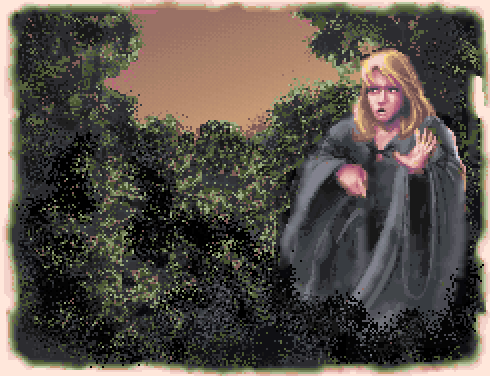
Which of the two lives in a hut depends on where the hut stands: on about every other square of the map she is a witch. Attacking the widow costs Virtue and Divine Favor.
A beaten witch offers five things for her life: roots of “unnatural strength”, three alchemical formulas, the place of the next High Sabbat, the cult’s calendar, or her penance. Never take the strength: the leader who eats the roots dies. The formulas are random and often land on the wrong party member or on a saint instead (see 3.3). Her penance trains Virtue and gives Divine Favor. Whatever you choose, sparing her calls the Wild Hunt down on the party (see 4.13).
4.11 Satanic Villages

About one village in ten falls under the witches’ sway. It is decided when the party first arrives, and it lasts three years. In such a village confession gives no Divine Favor. Be sure before you accuse anyone: accusing a good village costs your leader 2 Virtue and six hours, and nothing else happens. Beating the cultists of a bad one leads you to their altar on the hill, which you can deface, purge with alchemy, consecrate with a saint or a relic, or use to call up its demon and fight it. A purged altar leaves the village an empty ruin.
4.12 Dragons
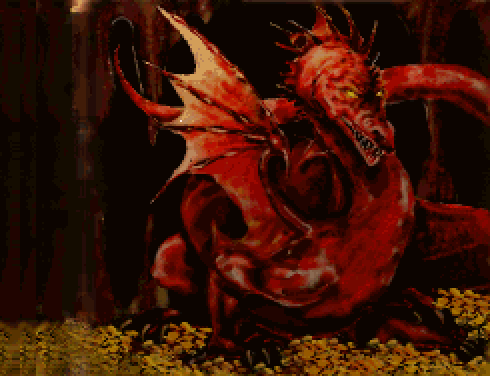
Truly, no medieval fantasy game would be complete without a dragon or two to slay. In Darklands, dragons take on the European archetype, as beasts from hell. Slaying a dragon immediately boosts your fame (not only reputation) by quite a bit: 64 fame on the normal level.
How do dragons appear, and how do I find one?
There is never more than one dragon at a time. At the turn of each month, if there is none, there is a one-in-four chance that a dragon settles in the lair nearest to the party, or in any of them if the party is out in the wild country at the time; there are eight lairs on the map. The quest lasts a year.
The surest sign is ruined villages. When the dragon arrives, every village within a short distance of its lair is burnt (40 map units east or west, 80 north or south), and those villages stay ruined for the rest of the game. Head for the ruins and search the wild country around them. Near the lair the usual road encounters give way to the dragon’s own: blighted land that rusts weapons and corrodes armour (Myles is right about your gear), witches, a rival dragon-slayer, a thief after the hoard, or villagers who want a maiden for the dragon (see 4.17).
In the lair you can fight, or have your leader reason with the beast. Reasoning succeeds with a chance of the leader’s Virtue in 300; it ends the quest and earns the fame, but there is no gold. Fail and the dragon wounds the leader and the fight begins anyway. Winning the fight gives 50 to 59 florins from the hoard, the fame, and standing in the city nearest the lair and in the city nearest to you. If you lose, the dragon carries off the most pious woman in the party, or anyone if there is none, and she is gone for good.
Dennis Ahr’s music change is not something the game’s rules show; treat it as a player’s impression.
4.13 Wild Hunt

Tales of the Wild Hunt are often whispered in hushed tones by aged adventurers. Hell’s hunter and their hounds will not easily be denied their game, but they can be turned back.
Hunts are called upon your party by the witches after hostile actions: sparing a beaten witch at her hut, or the summoning at a High Sabbat. They will descend upon your travelling party in the nighttime hours. Defeating the Hunt in combat only earns your party a temporary reprieve. It will return.
How does the Hunt work?
Once the Hunt has been called, each encounter on a night journey has a one-in-three chance of belonging to it. The game counts these nights. On the first, the hounds only pass by; on the second you meet their quarry, a fleeing creature of the woods; on the third, if you met the quarry, the Holzfrau appears. She whispers the name of the saint who can banish the Hunt. It is chosen at random from all the saints when the Hunt is called, so it differs from game to game. From the fourth such night on, the Hunt itself comes for you, and until she has told you the saint the Holzfrau comes back every third night.
When it does, you can:
- offer it a deer: needs a missile weapon in the party; the chance is two thirds of your best Woodwise;
- outrun it: if everyone is mounted, the chance is the lowest Riding in the party plus the quality of that same rider’s horse, so a Superb Horse (70) helps far more than a mule (5). If anyone is on foot, the option is still offered, and an original bug makes it succeed every time;
- pray: St. Eustace, St. Gertrude of Nivelles (her mists carry you to the nearest village) or St. Hubert;
- fight;
- banish it, shown only if someone in the party knows the Holzfrau’s saint.
Banishing ends the Hunt for good, or until a witch or a sabbat calls it again. A won fight only drives it off, and it comes back. A lost fight ends the Hunt too, but the hounds tear one party member to pieces first.
4.14 High Sabbat
Spoiler: the High Sabbat
The game keeps count of every slip: a failed bluff, a fight, anything that makes the cult wonder about you. At five slips the cult turns on the party. A Sabbat entered at the summoning also calls the Wild Hunt (4.13).
Victory gives every party member 3 Virtue and Divine Favor to the full, the party 25 fame, and the nearest city a rise in standing. It also breaks the First Seal, which is what opens Baphomet’s castle (4.16).
4.15 Great Monastery
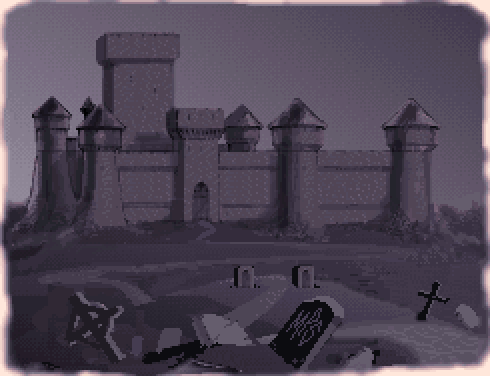
Spoiler: the Templars’ fortress monastery
The fifth member von Lünen means is a hired companion, and he stays a fixed time: a young Hanse 360 days, a village Schulz 90 (see 3.10).
What the game actually checks in the fortress:
- The graveyard. Only one name opens the way: Reinhard of OGronigen, on the dark stone. A wrong name, or digging, calls up the guardians. A saint can point the right name out.
- The password. Only “Beelzebub forever”. Any other word brings an ambush.
- The tilting floor. Perception doesn’t help. The leap succeeds with the lowest effective Agility in the party; disarming uses half the best Artifice; a Stone-tar, Thunderbolt, Eater Water or Arabian Fire potion jams it every time; a prayer to St. Lutgardis, St. Milburga or St. Christina the Astonishing carries you over. Better still, in the Hall of Horns before it, twist the stag horns (only the stag horns): that disarms the trap.
- The desk. One try per visit. The three formulas go to the member with the best Read & Write plus Speak Latin.
- The demon prince. You can call on St. Anthony, St. Clare or St. Dymphna, throw a potion, or attack, and each way leads into the same fight. The game’s text says Fleadust weakens him, as the skeleton promised, but the fight that follows is the same whichever potion you throw. Win it and the seal breaks: 64 fame, and the book shows where Baphomet’s castle lies.
The fortress doesn’t stay put. It starts at Lugum, north-west of Flensburg; each time it is cleared it moves to the next site, first south of Görlitz, then north-east of Graz, and after that there is no other.
4.16 Baphomet
Spoiler: Baphomet’s castle and the ending
What the game requires, gate by gate:
Getting in. The castle gate checks one thing only: that the First Seal has been broken. A High Sabbat victory and the fortress monastery’s demon both break it, so either one is enough; nothing inside the castle asks about the monastery. Without it, a floating mask turns you away.
The keys. The inner gate opens only for a party carrying all six Keys of the Apocalypse: the globe with the fish (from Lydwina’s burnt ship), the Lantern of Light, the Magic Honey, the Seed of Life, the Magic Balance and the Sword of War. Freeing Lydwina from her ship also breaks the seals of the later gates, so go there early.
The lake of fire. St. Cecilia takes you across unharmed. A prayer to St. Charity, St. Margaret or St. Polycarp, or a Firewall potion, gets you across singed. You can also wade (the chance is three times the weakest member’s Strength) or swim under the flames (three times the weakest Endurance); a bad roll burns the weakest member, a very bad one burns everyone and turns the party back.
Famine. Offering your money wins the Balance at once, and because of an original bug only the florins are taken: groschen and pfennigs stay in your purse. Offering souls costs everyone 99 Virtue and 99 Divine Favor. Offering lives kills a party member each time until only two are left. A prayer to St. Anthony of Padua or St. Isidore hints that the rich fear famine least.
The lancers. Ahr’s “goblins” are giant lancers riding goblin-beasts, and the “little goblin sword” is the Sword of War, one of the six keys. There are three ways to win it, each with a lasting cost:
- A champion fights one lancer; his chance is half his best hand-weapon skill. If he wins, his Strength and Endurance and their maximums drop by half; if he loses, by a quarter, and he may try again.
- The whole party attacks; the chance is half the party’s average Edged Weapons plus half the best hand-weapon skill. Every member then loses a quarter of the chosen member’s Strength and Endurance maximum (a sixth after a defeat), from both the current values and the maximums.
- Make peace through St. Apollinarius, St. Genevieve or St. Godfrey and “give a quart of blood”: everyone loses 5 points of maximum Strength and 19 of current Strength. Rest restores the current Strength, so this is the cheapest way.
The Great Dragon. It asks the party to kneel. Kneeling means giving it your most virtuous member, who dies, and everyone’s Virtue goes with it.
How it ends. Past the inner gate and its guardian, Baphomet looses six plagues; the six Keys are taken from you and undo them one by one. Then he offers a bargain.
- Accept, and every member gains 5 Strength, Endurance, Perception, Agility and Intelligence, current and maximum; the party gets 50 florins, 20 standing in every city and 50 in the nearest. There is no closing film.
- Refuse, and hope defeats him. The closing film plays; the party gets 200 fame (133 on Basic, 300 on Expert), 40 standing in every city and 50 in the nearest, and wakes up at the inn of the nearest city.
Either way the game goes on (see 3.16). The castle moves to the next site on a fixed list: from south of Salzburg to south of Pressburg, then to near Fulda.
4.17 Why are maidens sacrificed to a dragon, and can I stop it?
One of the four kinds of dragon quest is a maiden-eating dragon. When it settles, the nearest burnt village holds a contest to choose the fairest girl for the dragon, and armed peasants in the blighted country around the lair demand the party’s fairest woman as its next meal. You can rescue the girls at the stake by talking, force, stealth, speed or a thrown potion, and each one saved counts for the quest; but the dragon itself is fought only in its lair.
That village keeps holding its contest for the rest of the game, even after the dragon is dead: nothing in the game resets it. This is why players have reported a “permanent” maiden village, Höxter in some games, a different one in others. There is nothing more to win there once the dragon is slain.
4.18 When and where are the witches’ sabbats?
There is always one sabbat planned. It falls on one of eight feast days, picked according to the month:
| Day | Day | ||
|---|---|---|---|
| 21 March | spring equinox | 21 June | midsummer |
| 13 April | 22 September | autumn equinox | |
| 25 May | 31 October | All Hallows’ Eve | |
| 11 June | 26 December |
It begins at midnight of that day, lasts two days, and is held at one of the eleven sabbat sites, such as the Brocken, chosen at random; when it ends, the next one is planned. Beaten witches, the cult’s calendar and cursed villages (4.10, 4.11) tell you where and when. Come on the right days: at any other time there is no gathering at the site.
Because of an original bug, the sabbat quest ends on New Year’s Day 1500: from then on no sabbat is planned. If you mean to win the High Sabbat, do it before the end of 1499.
4.19 Tombs, the undead and purifying

Errands for city patrons (see 4.7) sometimes send the party to an item in a crypt beneath a ruined church, where the dead are not at rest. Getting in means moving the rubble or blasting it with a potion.
Inside, don’t take the item and fight. Taking it makes the dead rise, and because of an original bug a won fight sends you back to the map before the item is handed over: you get it only if you lose. Purify the crypt first, and the item is yours with no fight. A prayer to St. Boniface, St. Emydius or St. Raphael does it, or a Transformation potion: its chance is twice its quality plus ten (60% at 25q, 99% at 45q), and the potion is not used up.
The same three saints help against the undead at the source of a mine’s horrors (4.9).
4.20 How should I prepare for Baphomet? Can a small party do it?
Spoiler: preparing for the endgame
- Order. Win a High Sabbat (4.14) before the end of 1499; that alone opens the castle. The fortress monastery (4.15) is optional for Baphomet, but its relics, formulas and fame are worth having.
- Saints. Know St. Cecilia for the lake of fire. Bring St. Lutgardis, Milburga or Christina for the fortress trap, and one of St. Apollinarius, Genevieve or Godfrey if you would rather pay the lancers in blood than in a champion’s health.
- Potions. Firewall for the first gate and the lake; Essence o’Grace in quantity; Stone-tar or Thunderbolt for traps; Sunburst and Thunderbolt for the dragon.
- Money. Carry your wealth in florins only if you don’t mind Famine taking them; pfennigs and groschen survive.
- Saving. The castle and the fortress are among the places where you can save between fights (see 2.12).
The endgame tests the weakest member again and again: the lowest Agility at the fortress trap, the weakest Strength and Endurance at the lake of fire. A small party is not shut out: a party of one or two meets smaller enemy groups everywhere, because the game scales fights to the party’s size and skill (see 3.13).