Devlog #031 - Building from the Inside Out
There is a trap in reimplementing an old game. It is very easy to say the word “faithful” and then quietly build something that only resembles the original from a comfortable distance.
That is not what this project is trying to do.
The Darklands Restored engine is not a loose remake, and it is not an opportunity to build a cleaner game now that better tools exist. The goal is more specific and, in some ways, more demanding: to reconstruct what the original game actually did, in a form that a modern host can understand and present.
The distinction matters more than it might sound.
Why behavior, not appearance
A surface-level reimplementation might say: show an intro, play some music, go to the menu. That is achievable in an afternoon. The result can look convincing without capturing anything real about the original game.
What the restoration project asks instead is: which files did the game open, and in what order? Which branch did it take? What did the display contain at each step? What did the keyboard input actually produce? What portion of an audio file did the sound system request, and when? What do we know for certain, and what are we still guessing?
Those are harder questions. They require weeks of runtime observation, format analysis, and careful study of the game’s behavior. But they are the right questions, because answering them is the only way to build something that genuinely understands what Darklands was doing rather than something that merely imitates it from the outside.
The split that makes this work
It was important to define the architecture from the very start. The current architecture divides the project cleanly into two layers.
The core engine owns the behavioral model: the startup sequence, the intro asset order, frame data, palette data, audio cue identities, input events, and the distinction between what is confirmed and what is still open. It has no dependency on any display library. It does not know what a GPU texture looks like.
The host layer takes the events the core produces and turns them into something visible and audible. The current host uses SDL2 for easy testing. A future host could use another engine or frontend. Both would consume the same core events without requiring the engine to change, making it possible to port the engine to any other type of frontend host.
This is not a clever abstraction for its own sake. It is what makes the project viable long-term. The research will keep producing more precise answers about original behavior, and those answers need somewhere stable to land. If the display layer and the behavioral model are tangled together, every new discovery requires untangling them first.
Architecture as a contract
The important architectural choice is that the core does not present the game. It describes what the original runtime did.
That means the core is responsible for producing a stream of facts and requests: a frame is ready, a palette changed, a display boundary was reached, a sampled audio cue was requested, a startup resource was loaded, a key was interpreted as an original BIOS input word, or a branch moved execution toward the start screen.
The presenter is responsible for translating those facts into a modern environment. The current SDL host turns indexed frames into textures and DGT windows into queued audio. Another engine host would translate the same events into its own textures, audio clips, input actions, and scene objects. The core should not care which host is being used.
    flowchart TD
    Evidence["Original evidence"] --> Core["Host-neutral core"]
    Core --> Events["Runtime events"]
    Events --> SDL["SDL presenter"]
    Events --> Other["Other engine presenter"]
    Events --> Tools["Tools and diagnostics"]
This gives the project two different kinds of stability.
The first is research stability. When a runtime trace proves a new detail, that detail lands in the core as a better event, a better source window, a better fidelity marker, or a better branch target. It does not require rewriting the SDL renderer.
The second is presentation stability. If the project later gains a different frontend, a high-resolution art path, or another audio backend, those systems translate the same core events. They do not become the source of truth for game behavior.
A useful way to think about the boundary is this:
    flowchart LR
    Core["Core owns behavior"] --> Presenters["Presenters translate behavior"]
    Presenters --> Video["Video"]
    Presenters --> Audio["Audio"]
    Presenters --> Input["Input"]
The direction matters. Input from a host is translated back into original-style facts before Core sees it. Output from Core is translated into host-specific presentation after Core emits it. The core remains the place where original behavior is reconstructed, and the host remains the place where that behavior is made visible, audible, and playable on a modern machine.
This is why the project can support replacement assets without becoming a
different game. A future host may choose to show a higher-resolution version of
a screen, or play a cleaner recording of intro.lightning, but the decision
that the original runtime requested intro.lightning at that point still comes
from Core. The presenter can improve presentation. It does not rewrite history.
What exists now
The project is currently a .NET 8 solution with a headless core, a tools project, a test suite, and the SDL host.
I decided to start with the full start-up sequence up to the main menu.
The startup sequence is modeled from the beginning: the text-mode banner that appears before any graphics are initialized, the configuration file that selects the sound hardware setup, the loading of graphics support and fonts, the sound module initialization, and the transition into the intro sequence.
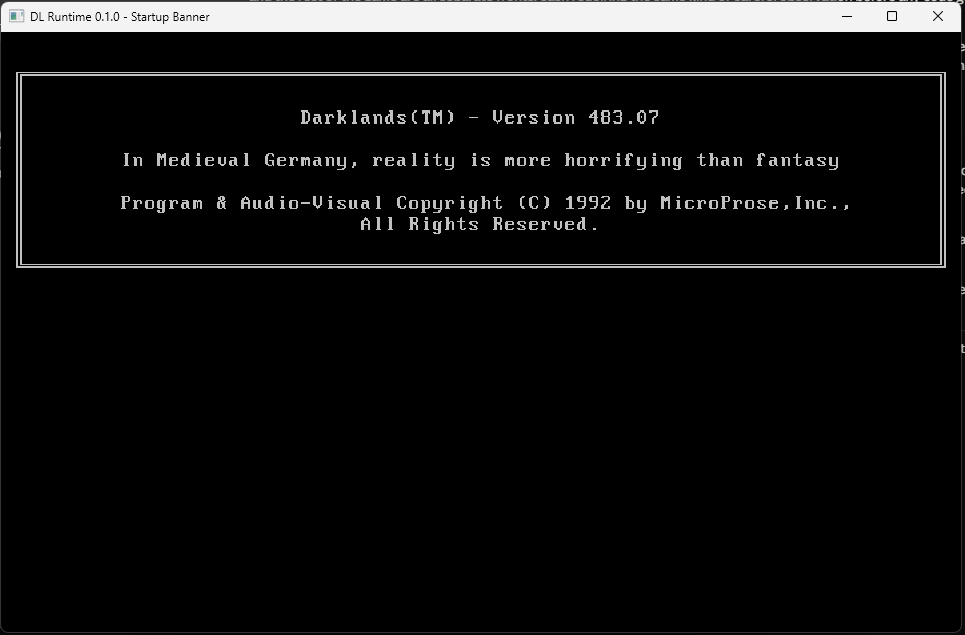
The startup banner, rendered from BANNER.DAT using the original DOS text layout. CP437 box characters, inline color attributes, and the original version string, all before the graphics mode has been touched.
The intro plays all seven original PAN files in the correct order. The display goes blank, the palette updates, and the next scene appears, in the same pattern the original game used.
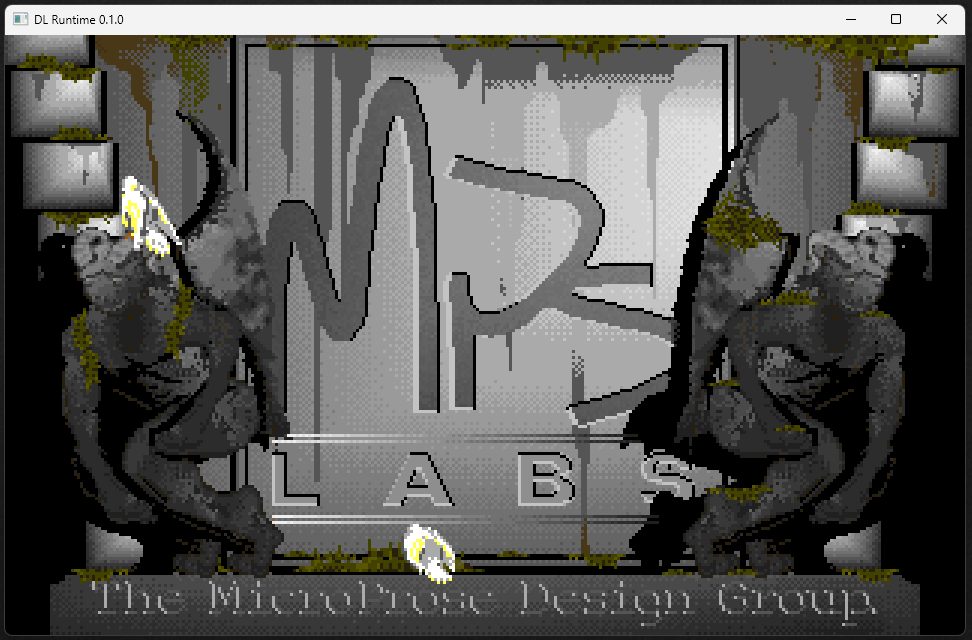
A frame from OPENING2.PAN, the first scene in the intro sequence. The gargoyles and the MicroProse Design Group title, decoded by the engine and presented by the SDL host.
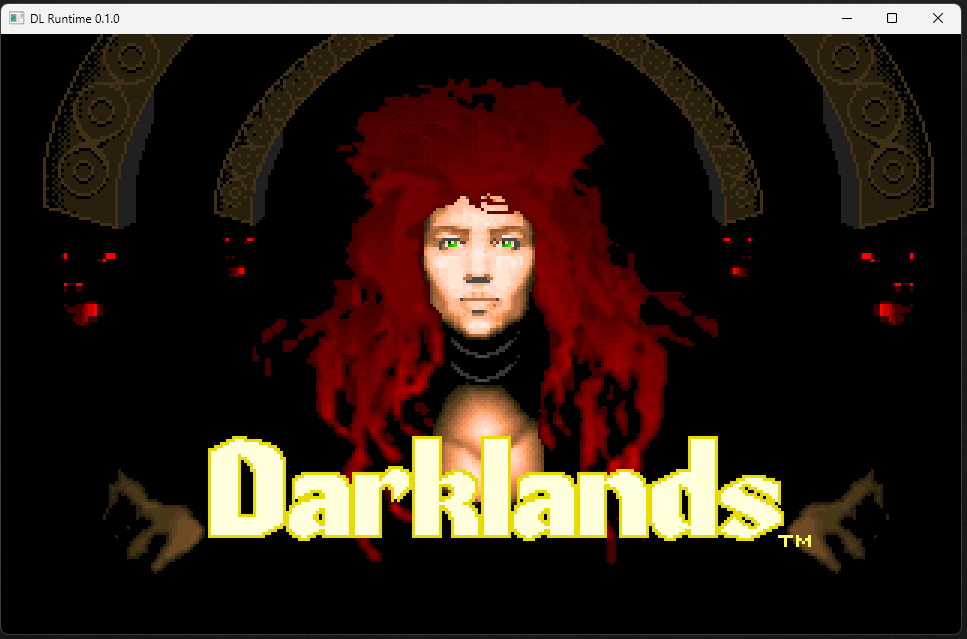
A frame from later in the intro sequence, showing the Darklands title card.
At the end of the intro, the engine lands at the start screen and waits for input.
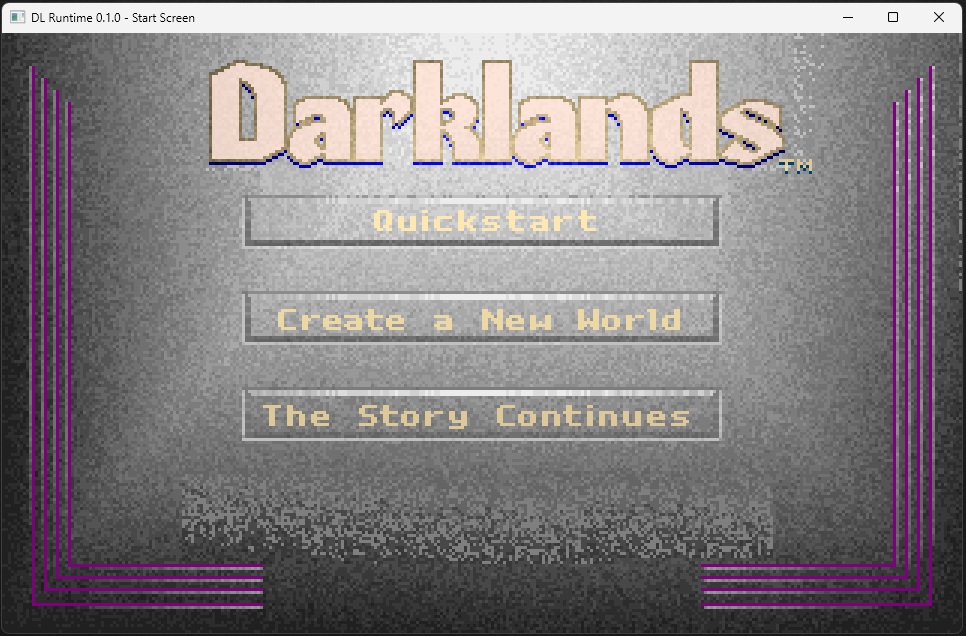
The start screen, reached at the end of the intro sequence. Quickstart, Create a New World, and The Story Continues are all mapped and confirmed.
The PAN decoder was built directly from the format research described in devlog #028. It produces frame-by-frame output that matches the original game’s display, verified against captures from the running game at selected points.
The test suite covers 59 cases: asset ordering, frame counts, event shapes, specific frame hashes, and the boundary between confirmed behavior and placeholder estimates.
Fidelity markers
One of the most useful decisions was to make uncertainty explicit in the code itself.
Every significant behavior in the core carries a label. Some behavior is confirmed, meaning it is backed by direct observation of the running game. Some is strongly supported, meaning multiple sources agree but one detail is still open. Some is a placeholder, meaning the shape is right but the exact original behavior is not yet fully understood.
This is not bureaucracy. It is how the project stays honest about what it knows.
The audio side is the clearest example. The file (OPENDARK.DGT) that carries the “Welcome to Darklands” voice during the intro also contains the bell, the toad, and the lightning effects heard throughout the sequence. Each of those is a distinct window within the same raw audio file. The project knows the precise byte offsets and lengths for each one.
So the core emits a semantic audio request with an identifier and the original source window attached. The SDL host can play the original bytes directly. A future host can map the identifier to a replacement recording. A diagnostic build can log the original offset. All of them consume the same event. The placeholder label on the timing is visible in the code, not hidden behind a comment.
That pattern, preserve the original observation, expose a useful contract, label what is still open, is the standard the project is trying to hold everywhere.
What is still ahead
The intro layer is now solid. The start screen is modeled at the top level, with the three main menu actions confirmed. What happens after each of those choices is still being mapped. The party creation screen, character generation, city navigation, and the rest of the game are all separate fronts, each requiring the same careful observation before any code gets written.
The audio path also needs more work. The scheduler that sequences the sampled intro effects, even if we now have them correctly mapped to the precise PAN frame, is not yet fully understood. The intro music layer, which runs separately from the voice clips, is evidenced but not yet connected to a specific playback path. This is coming soon.
The question this project is actually answering
The easy question is whether something can be made that looks like Darklands. It can.
The harder and more interesting question is whether a modern engine can genuinely understand what Darklands was doing: which decisions the game made, which files it touched, which paths it took, and why the screen showed what it showed.
That is what the research earns and what the implementation is trying to reflect. Every piece of confirmed behavior is backed by a runtime observation or a decoded format. Every placeholder is labeled as such. Nothing is invented to fill a gap and then left unmarked.
It is slower than building a remake. It is also the only way to build something that is actually faithful to the original rather than just reminiscent of it.